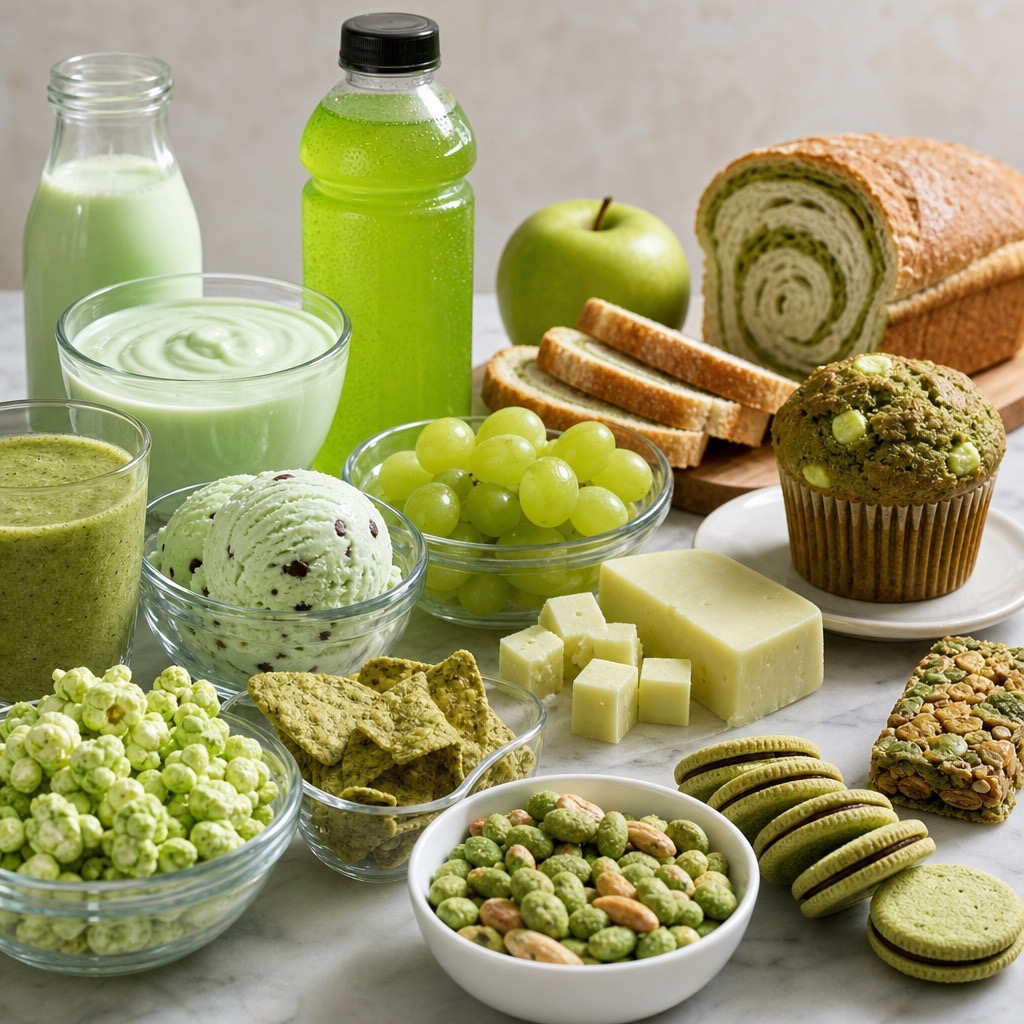
Green demands extra planning
Get in touch to request samples, discuss custom formulations, or obtain volume pricing for your supply chain.
talk to a color expertChlorophyll and chlorophyllin-based colorants do exist and have a genuinely natural origin story. Still, their approval status and stability performance vary enough across markets and applications that they have not become a universal green solution, as betanin or beta-carotene have for other colors. In practice, most manufacturers end up building green through the blending approach covered in our spirulina and yellow post rather than relying on a chlorophyll-based source alone.
Because a natural green is almost always a blend of blue and yellow pigments, it inherits the stability challenges of both components simultaneously rather than facing the limitations of a single pigment. This compounding effect is the primary reason green consistently ranks among the more challenging natural colors for manufacturers to formulate successfully.
The most frequent failure mode in a natural green formulation is not total color loss but an uneven shift, in which one pigment degrades faster than the other, causing the blend to drift toward blue or yellow rather than fading evenly. This is often more noticeable and damaging to a product's shelf appeal than a straightforward fade would be in a single-pigment system.
Formulators sometimes price and dose a green blend based on the individual use rates of its blue and yellow components, tested separately, without accounting for how the combination behaves at scale. Real production batches may require adjustments once both pigments are combined, and failing to plan for them during early cost modeling leads to budget surprises later in development.
A yellow source like turmeric already carries its own flavor considerations, and adding a second pigment on top of it compounds the risk of an off-flavor that would not have shown up with either ingredient alone. Testing the flavor impact of the full blend, not just each component individually, is essential yet often skipped.
As covered in our spirulina and yellow post, any green blend should be formulated and packaged around the more sensitive of its two components, typically the blue source, rather than treating both pigments as equally robust.
Every stability and shelf-life test should evaluate the finished green blend directly, rather than extrapolating from data collected on each pigment separately, since the interaction between the two components is exactly where most real-world failures occur.
Given the added complexity of formulating two pigments together, green reformulation projects generally require more development time than a single-pigment color category, and planning for that up front helps avoid a compressed, rushed validation process later.
Beverages benefit from the relatively controlled, uniform environment that a liquid system provides, which makes it easier to maintain a consistent pH and reduce the risk of uneven degradation between the blend's two components compared with a more complex solid food matrix.
Bakery and snack applications introduce the heat-exposure challenges covered throughout this series, and a green blend built on spirulina generally needs to be applied after baking, as an icing, glaze, or coating, rather than mixed directly into a batter that will undergo a full oven cycle.
Confectionery applications benefit from the same genipin-based stability advantages covered in our blue color posts when a jagua or gardenia blue base is used in place of spirulina, offering a genuinely more heat- and pH-stable starting point for a green blend in products that require it.

© 2026 Vivify company llc | All Rights Reserved | SITEMAP | ACCESSIBILITY statement | TERMS