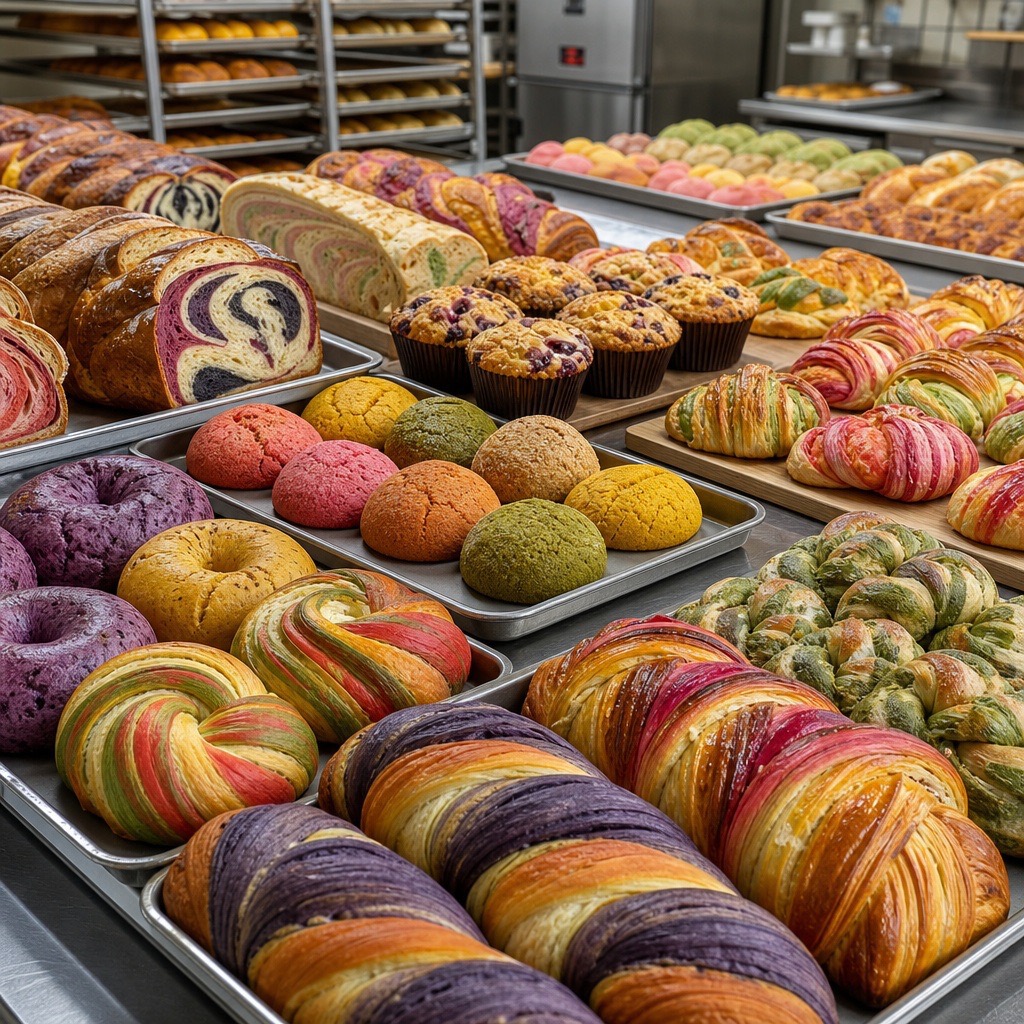
Bake-Stable Color Selection
Get in touch to request samples, discuss custom formulations, or obtain volume pricing for your supply chain.
talk to a color expertNatural colorants used in baking are typically derived from fruits, vegetables, minerals, and other edible sources — think beta-carotene from carrots, anthocyanins from red cabbage or black carrot, curcumin from turmeric, or spirulina extract for blue-green shades. Each source carries its own solubility profile, hue range, and heat tolerance, which is why “natural” is a starting point for formulation, not an endpoint.
Natural colors arrive in multiple formats — water-soluble liquids, oil-dispersible forms, powders, and emulsions. The carrier system matters as much as the pigment itself: a powder that disperses cleanly in a high-fat shortbread dough may clump or streak in a low-fat sponge batter. Matching the carrier to the matrix is one of the first technical decisions in bakery color selection.
Baking subjects color systems to sustained heat — often 300–450°F for anywhere from a few minutes to over an hour. Some natural pigment classes, like carotenoids, tolerate this reasonably well; others, like certain anthocyanins, are more heat-labile and can fade or shift hue during the bake.
The Maillard reaction and caramelization naturally darken the surfaces of baked goods, which can visually compete with or mute an added color — particularly lighter pastel shades. Formulators need to account for this “background browning” when targeting a final in-mouth color, not just the color of the raw batter or dough.
Higher moisture, longer bake times, and often a more neutral-to-alkaline pH from leavening agents make batters a demanding environment. Colors with proven heat and pH resilience typically perform best here.
Lower moisture and often shorter bake times can be more forgiving, but higher fat content shifts the requirement toward oil-dispersible or fat-compatible colorforms.
Fermentation time, surface treatments (washes, glazes), and extended bake windows introduce additional variables — color needs to survive both the proof and the oven.
Because color performance is matrix-dependent, what works in one bakery formulation may not translate directly to another. Small-batch bench trials — testing a candidate color at actual use levels in the target application — remove the guesswork before scale-up.
A distributor with in-house formulation and regulatory expertise can shortlist candidate colors based on the specific bake profile, pH, and fat content of a client's product — cutting down trial-and-error cycles and reducing reformulation risk later in development.

© 2026 Vivify company llc | All Rights Reserved | SITEMAP | ACCESSIBILITY statement | TERMS