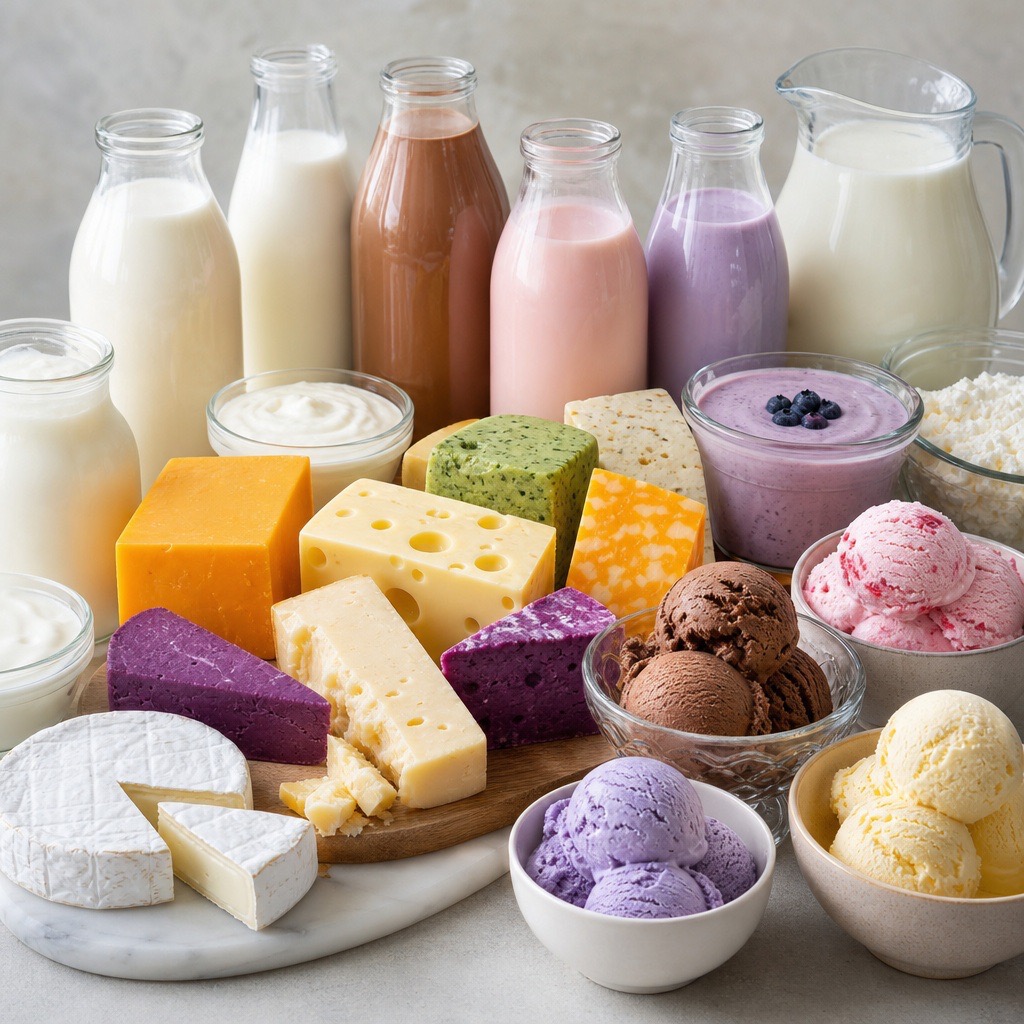
Dairy Category Color Guide
Get in touch to request samples, discuss custom formulations, or obtain volume pricing for your supply chain.
talk to a color expertUnlike clear beverages, milk starts from an opaque white base, which changes how color is perceived — pastels and lighter tones can wash out, while achieving a bold, saturated shade (like a deep chocolate or strawberry pink) often requires higher use levels than a clear liquid would.
Milk processing steps like homogenization and pasteurization apply mechanical and thermal stress that a color needs to survive without shifting shade or separating from the fat globules it's dispersed alongside.
Yogurt's fermentation process creates a low-pH, biologically active environment — colors need to be both stable under acidic conditions and compatible with active cultures, without interfering with fermentation or shelf-life stability.
Fruit-on-bottom, swirl, and layered yogurt formats often use color in the fruit preparation itself, introducing a stability profile distinct from that of the base yogurt. These two components need to be evaluated together, not separately.
Cheese coloring has some of the longest natural-color history in the food industry — annatto-based orange cheddar coloring is a well-established example. Newer natural cheese applications extend this tradition to a wider range of colors in specialty and novelty cheese products.
Cheese production often involves heating, aging, and sometimes smoking — each of which can affect color stability differently than in a fresh, unaged dairy product, requiring colors proven to hold through the full production and aging timeline.
Ice cream color needs to remain stable through freezing, extended frozen storage, and the freeze-thaw cycling that can occur during distribution — a distinct set of stressors compared with other dairy categories. (This category has enough nuance to warrant its own deep-dive — see our companion post on selecting natural colors specifically for ice cream.)
The base ice cream color often needs to coordinate with mix-in colors (candy pieces, fruit swirls, sauces) for a cohesive final product appearance, adding a layer of coordination beyond single-color stability.

© 2026 Vivify company llc | All Rights Reserved | SITEMAP | ACCESSIBILITY statement | TERMS