Replace Yellow 5 confidently
Get in touch to request samples, discuss custom formulations, or obtain volume pricing for your supply chain.
talk to a color expertYellow 5, known chemically as Tartrazine, and Yellow 6, known as Sunset Yellow FCF, were both named in the FDA's April 2025 announcement to be voluntarily reduced in use as an industry commitment rather than a formal FDA rule. The agency's own language has shifted from an original end-of-2026 target to an end-of-2027 target, with no formal announcement explaining the change. There is currently no non-regulatory mandate or penalty at the federal level for the continued use of either dye.
West Virginia enacted the first statewide ban on all seven major synthetic dyes, including Yellow 5 and Yellow 6, with school meal restrictions taking effect in August 2025. A federal court has temporarily blocked the broader statewide retail ban following an industry lawsuit, illustrating how unsettled this landscape remains. California, Virginia, and Utah have their own school meal restrictions on separate timelines, and some major manufacturers, including General Mills and Kellogg, have made public pledges to remove synthetic dyes from their US lines on schedules that in some cases run through 2027. For a national brand, tracking the fastest-moving state or retailer requirements remains more useful than watching the federal deadline alone.
Both Yellow 5 and Yellow 6 tolerate heat, light, and a wide pH range better than most natural yellow sources, mirroring the gap covered in our Red 40 replacement guide. Riboflavin is the strongest natural option for heat-intensive processes. At the same time, turmeric performs best in applications added after the main heat step, similar to how anthocyanins and betanin are best reserved for post-bake bakery applications.
As with every natural-to-synthetic swap covered in this series, expect a higher use rate and a different cost position than the synthetic dye being replaced. Building this into the reformulation budget early avoids surprises during a pilot run.
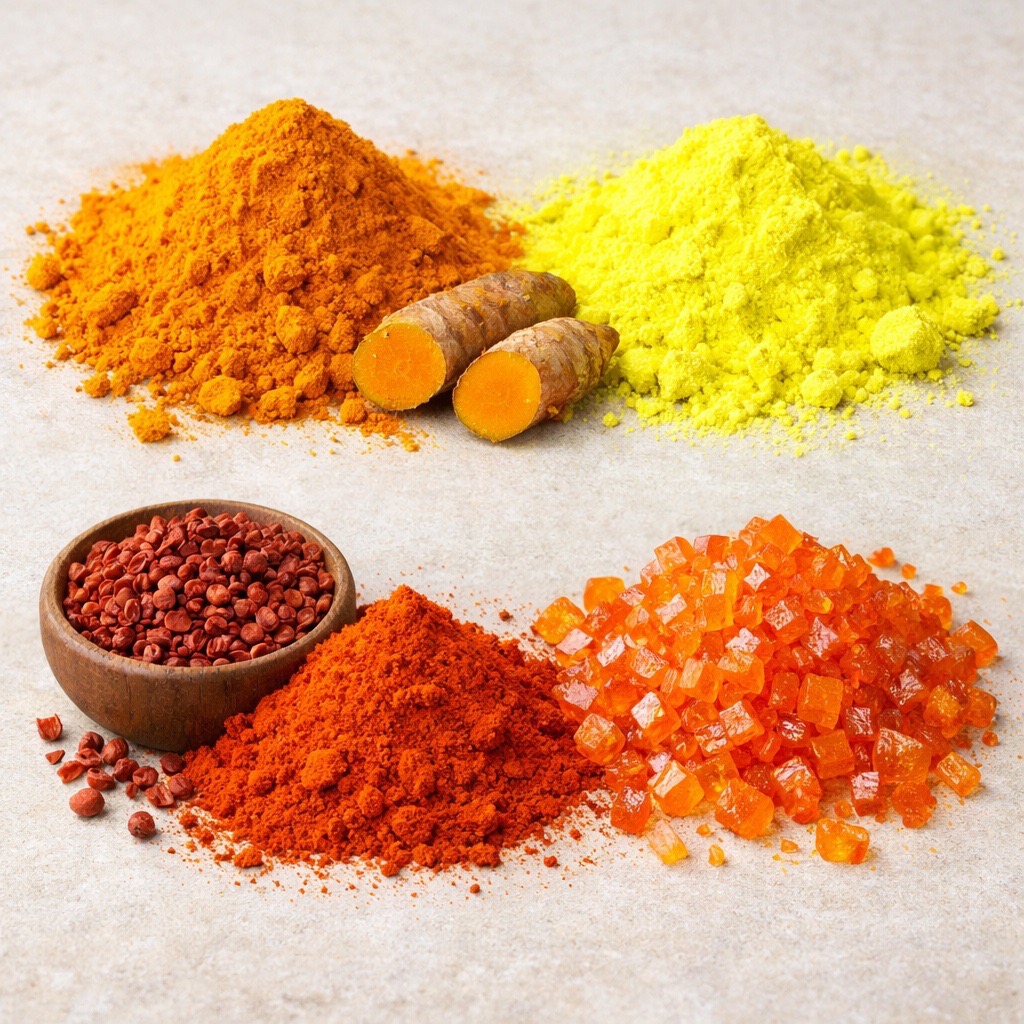
A blend of turmeric and annatto, or of riboflavin and a small amount of beta-carotene, is often the most reliable way to land precisely on the original shade of Yellow 5 or Yellow 6, rather than settling for the closest single source.
Start with a complete list of all products containing Yellow 5 or Yellow 6, grouped by application type rather than by brand, following the same process outlined in our Red 40 roadmap. Grouping by system allows a team to apply what works in one beverage or snack line to similar products, rather than solving each one from scratch.
Every candidate replacement should be piloted at production scale and checked across the full expected shelf life under real storage and display conditions. Turmeric, in particular, can look correct at launch and still drift over time in an alkaline or long-shelf-life product, so this step is not optional.
Once a formulation changes, review the ingredient statement and any color-related claims with the regulatory and marketing teams. Current FDA guidance allows a broader range of formulations to carry a no artificial colors claim than some teams may expect, so it is worth confirming exactly what claim language is supportable before finalizing new packaging.

© 2026 Vivify company llc | All Rights Reserved | SITEMAP | ACCESSIBILITY statement | TERMS