Processing Drives Pet Food Color
Get in touch to request samples, discuss custom formulations, or obtain volume pricing for your supply chain.
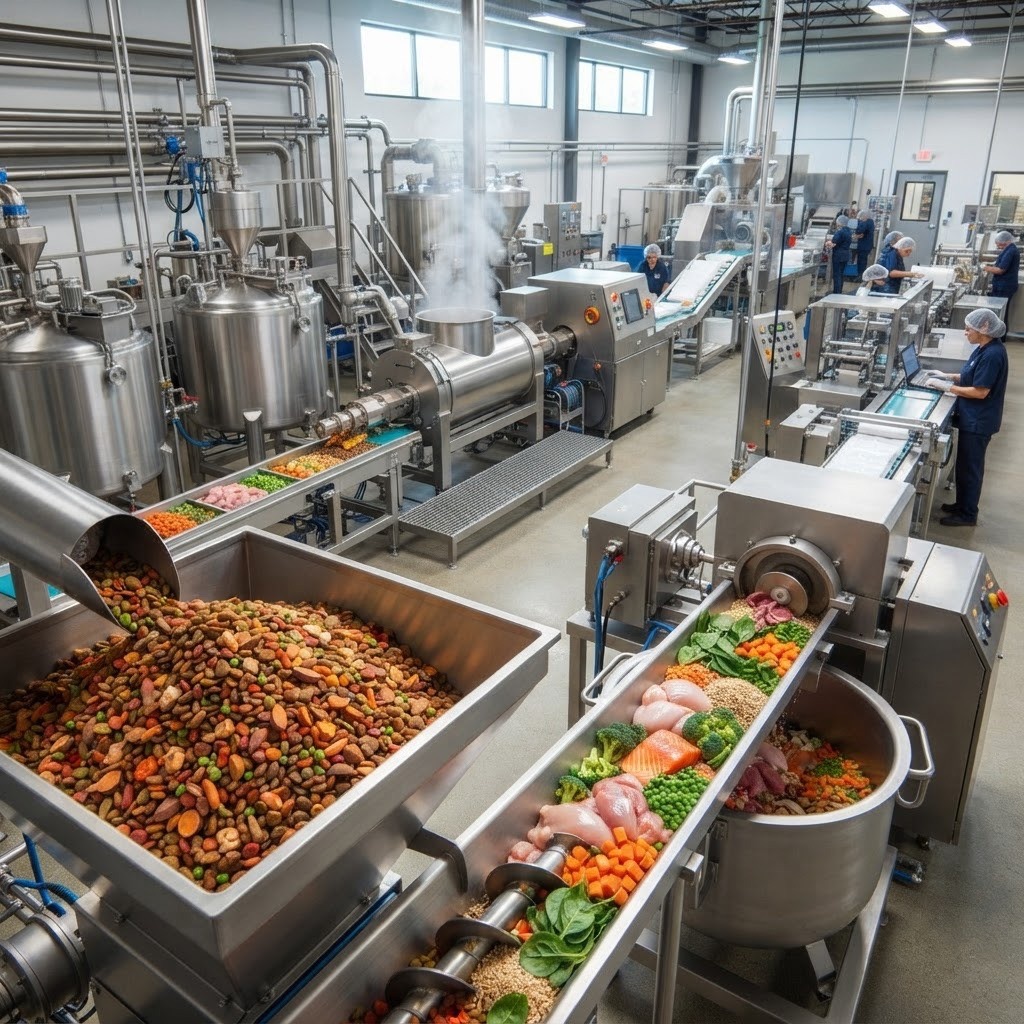
talk to a color expertExtrusion combines elevated temperature, high pressure, and significant mechanical shear in a single continuous process — a uniquely demanding combination that goes beyond the heat-only stress covered in our bakery series and requires colors specifically validated for extrusion conditions rather than heat tolerance alone.
Unlike a bake cycle that may run for extended periods at moderate heat, extrusion typically applies intense conditions over a much shorter residence time — meaning color stability testing needs to reflect this specific time-intensity profile rather than assuming longer, lower-heat exposure data will translate directly.
Retort processing sterilizes wet and canned pet food through sustained high-temperature treatment, placing significant thermal demand on color stability — often exceeding the thermal intensity of the pasteurization and UHT processes discussed in our dairy series.
How heat transfers through a can, pouch, or tray during retort processing can vary by package format and fill volume, meaning color performance validated in one package format shouldn't be assumed to transfer directly to a different retort package configuration.
Applying color as a post-extrusion spray or coating — rather than incorporating it into the feed — is a common strategy to avoid direct exposure during extrusion, echoing the post-extrusion coating approach discussed in Blog 2 of this series.
While post-processing application can improve color retention, it adds a manufacturing step. It introduces its own adhesion and uniformity considerations — a trade-off worth evaluating against simply selecting a more extrusion-stable color for direct incorporation.
As emphasized in our confectionery series' processing-focused post, mapping a formulation's specific time-temperature-shear profile — whether extrusion, retort, or baking — before selecting a candidate color leads to a more efficient, targeted formulation process than testing colors reactively after a process is already locked in.
Pilot-scale extrusion or retort trials don't always predict full commercial-line performance exactly — ongoing collaboration with a technical partner through scale-up helps catch process-related color issues before they become a costly full-batch problem.

© 2026 Vivify food & beverage | All Rights Reserved | SITEMAP | ACCESSIBILITY statement | TERMS