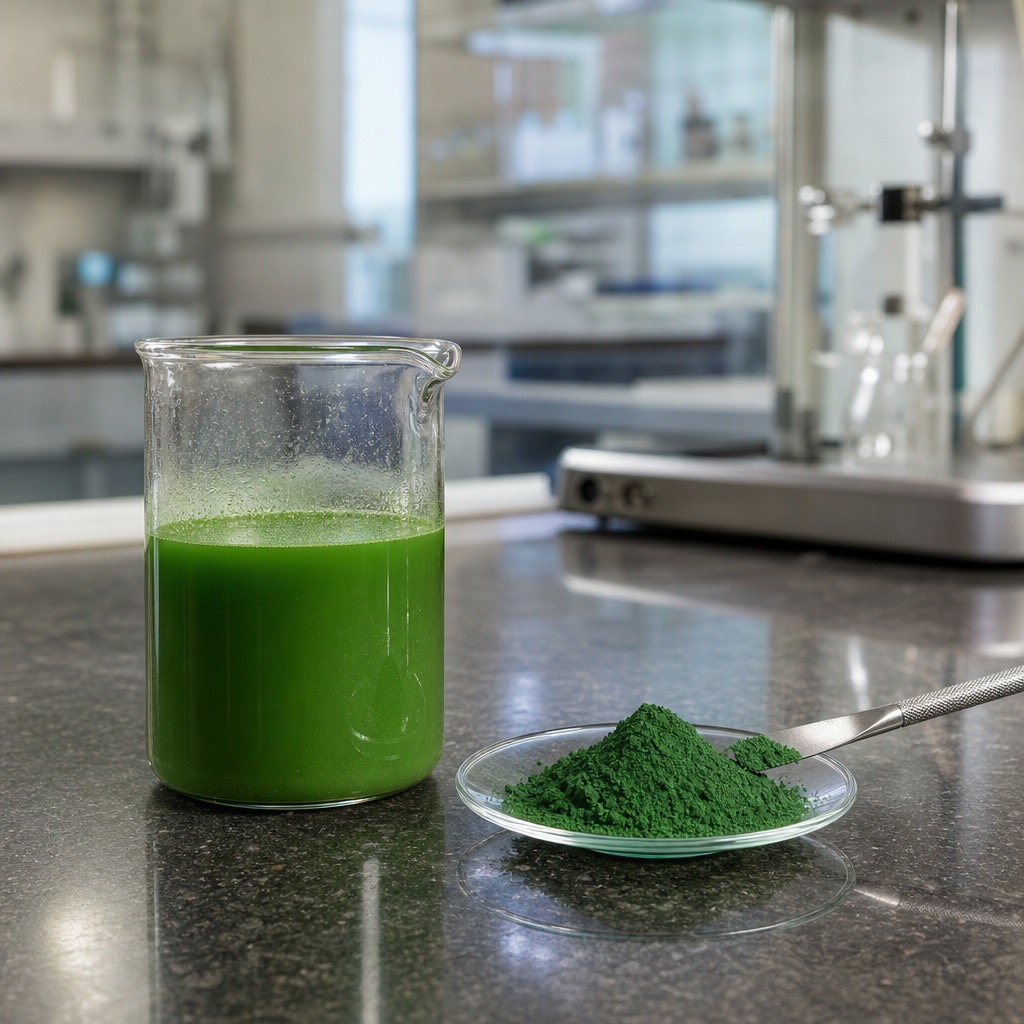
Blending builds every green
Get in touch to request samples, discuss custom formulations, or obtain volume pricing for your supply chain.
talk to a color expertFood coloring follows subtractive color mixing, the same principle behind mixing paint, in which combining pigments absorbs more of the visible light spectrum, and the remaining reflected light determines the perceived color. Blending a blue pigment with a yellow one absorbs enough of the red and violet portions of the spectrum that green light dominates what reaches the eye, which is the underlying reason this specific pairing produces green rather than some other combination doing the same job.
Most colors covered elsewhere in this series can be achieved with a single pigment at the right concentration, with blending used mainly to fine-tune an exact shade. Green is different because, as covered in our natural green challenges post, no widely available single pigment produces green on its own, which makes blending not an optional refinement but the primary way to get there at all.
Spirulina paired with riboflavin, turmeric, or another yellow source, covered in detail in our spirulina and yellow post, remains the most common and reliable path to a natural green, since both components have food use and predictable behavior on their own.
Jagua or gardenia blue, both covered in our blue color series, can be paired with a yellow source as an alternative to spirulina, generally offering better heat and pH stability at the cost of a more limited list of approved uses, which needs to be checked before selecting this route for a specific application.
Because the blue pigment is typically the more stability-sensitive of the two components, it makes sense to select and validate the blue source first, then choose a yellow partner that complements its stability profile, rather than the reverse.
Small changes in the ratio between the blue and yellow components can shift the resulting green significantly, more than equivalent small changes typically do in a single pigment system, so ratio adjustments during formulation should be made and evaluated in small, deliberate increments rather than large jumps.
Because the two components in a green blend rarely degrade at the same rate, the ratio that looks correct on day one may not be the ratio that looks correct at the end of shelf life, so formulating with a small margin toward the more stable component can help the blend age more gracefully.
The most common mistake is validating each pigment separately and assuming the combined result will behave predictably, when in practice the interaction between the two components, covered in our natural green challenges post, is where most real formulation problems actually appear.
When a green blend starts to drift during shelf life testing, the instinct is often to add more of whichever pigment seems to be fading faster, but this can overshoot the target and create a new, different color problem rather than solving the original one. Diagnosing which component is actually driving the drift before adjusting the formulation avoids this trap.
Every green blend should go through the same full-scale,full-shelf-life validation process covered throughout this series before committing to production, since the added complexity of a two-pigment system makes it more, not less, important to test thoroughly rather than assuming individual pigment data is sufficient.

© 2026 Vivify company llc | All Rights Reserved | SITEMAP | ACCESSIBILITY statement | TERMS