Stability Depends on Chemistry
Get in touch to request samples, discuss custom formulations, or obtain volume pricing for your supply chain.
talk to a color expertColor degradation under heat is generally a function of both temperature and exposure duration — a short, high-heat flash bake stresses pigments differently than a long, low-temperature bake. Understanding a formulation's actual time-temperature curve, not just the oven set point, is essential to predicting how a color will hold up.
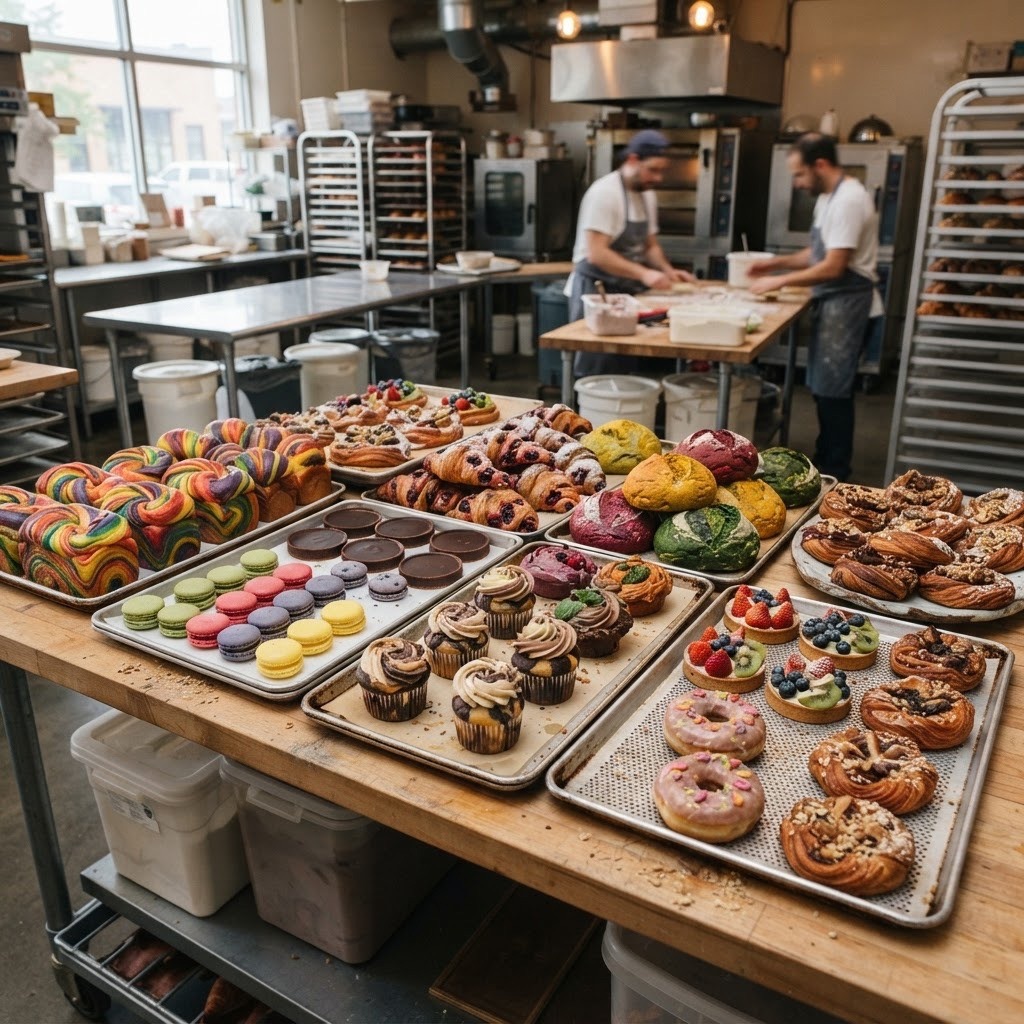
Different natural pigment families degrade at different rates: carotenoids (oranges, yellows) tend to be comparatively heat-stable, while some anthocyanins (reds, purples, blues) are more heat-sensitive and prone to fading or browning under prolonged thermal stress.
Anthocyanins are especially known for their pH-dependent color: the same pigment can appear red in acidic conditions, purple near neutral, and blue-green in alkaline conditions. Leavening systems, dairy inclusions, and other ingredients can shift a formulation's pH enough to alter the intended shade visibly.
Baking soda, certain proteins, and mineral-fortified flours can nudge a batter's pH during mixing or baking. Flagging these ingredients early in formulation helps predict — and correct for — potential color drift before production.
Fat content changes which color forms will disperse evenly. Water-soluble colors can streak or separate in high-fat systems like shortbread or laminated doughs, while oil-dispersible or emulsified colors are designed to distribute more uniformly through fat-continuous matrices.
Even the right color form can underperform if added at the wrong stage in the mixing process. Incorporating color into the fat phase before combining it with the dry or liquid phases often improves uniformity compared with adding it late in the process.
Microencapsulation and other protective delivery formats can shield sensitive pigments from heat, oxygen, or pH swings until later in processing, improving retention through the bake.
Combining two or more natural pigment sources can sometimes produce a more heat- and pH-stable overall shade than relying on a single source — a technique worth testing when a target hue proves difficult to hold with one colorant alone.

© 2026 Vivify company llc | All Rights Reserved | SITEMAP | ACCESSIBILITY statement | TERMS