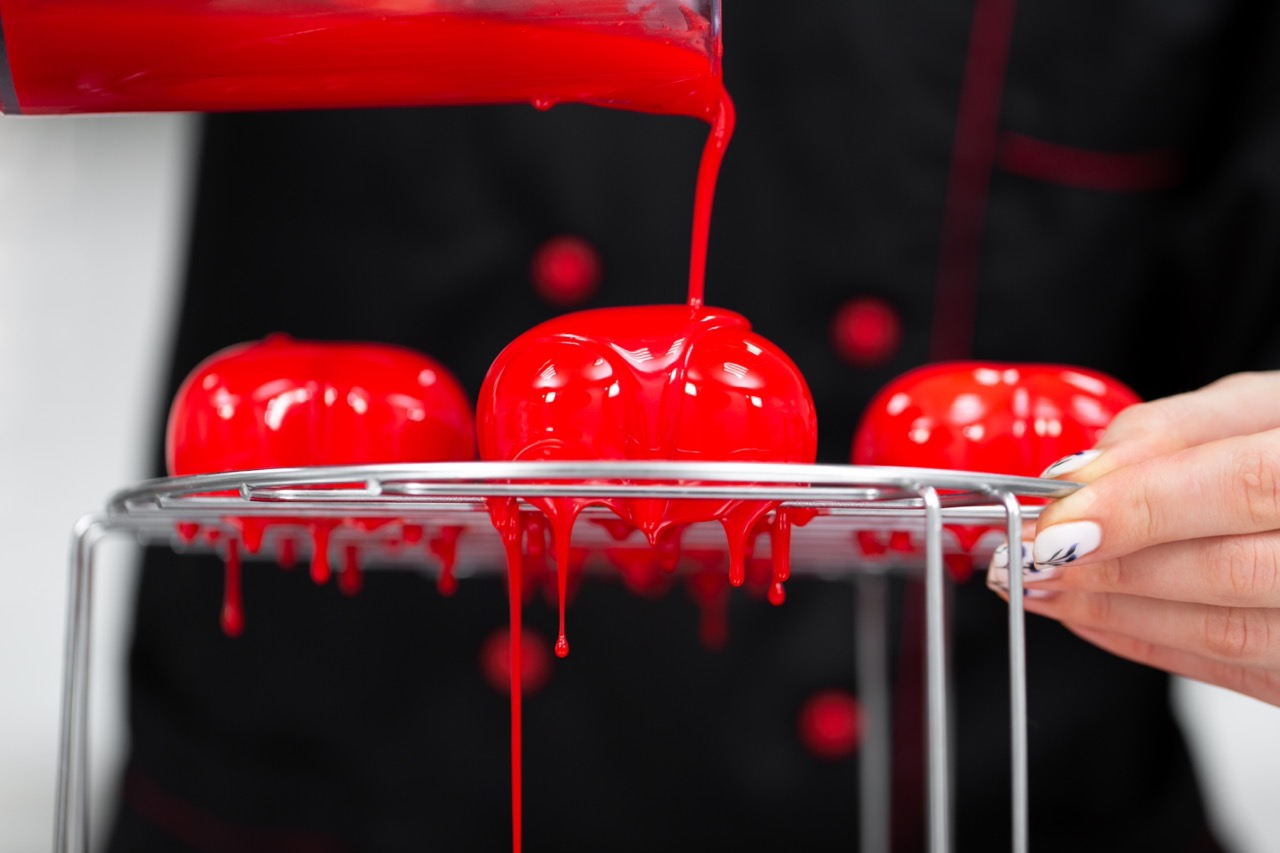
Vibrant natural finishing color.
Get in touch to request samples, discuss custom formulations, or obtain volume pricing for your supply chain.
talk to a color expertIcings, fillings, and decorations are applied after baking, which removes the single toughest stressor natural colors face: direct oven heat. As covered in our bakery stability post, pigments like anthocyanins and betanin degrade quickly at baking temperatures. Still, they perform beautifully in buttercream, fruit filling, or as piped decorations that never see the inside of an oven. This makes finishing applications the easiest place in the entire bakery case to achieve bold, true natural color.
Icings, fillings, and decorations carry more visual weight than crumb color. A cake’s frosting, a donut’s glaze, or a cookie’s sanding sugar is often the first thing a shopper notices, and it sets the expectation for flavor before the first bite. That makes vibrancy nonnegotiable in these applications, even as brands move away from synthetic dyes that made bold color easy to achieve at low use rates.
Icing chemistry determines which pigments will work. Buttercream is a fat-based system built on butter or shortening, so it favors naturally oil-soluble pigments like carotenoids, which disperse evenly and hold their color well. Royal icing, made with egg white or meringue powder and sugar, is water-based and pairs well with water-soluble pigments like anthocyanins and betanin. Cream cheese icing sits in between, with enough fat content that oil-soluble pigments generally blend more evenly than water-soluble ones.
Fruit fillings are typically water-based and naturally acidic, which is close to ideal territory for anthocyanins, allowing them to hold a true red or purple without the color drift that shows up in more neutral or alkaline systems. Cream fillings behave more like cream cheese icing and favor oil-soluble pigments for even dispersion. Ganache presents its own challenge: its dark chocolate base means any added color needs sufficient strength to show through, and only oil-soluble pigments will disperse into the cocoa butter without separating.
Fondant is a low-moisture sugar paste that can absorb concentrated gel or paste colorants without disrupting its texture, making it one of the more forgiving canvases for natural pigments. Chocolate work follows the same fat-only rule as ganache, since anything water-soluble added to melted chocolate will cause it to seize. For sanding sugars, dusting powders, and other dry decorations, dry pigment powders such as turmeric, beet, or spirulina powder are coated directly onto the sugar crystal or dusted on as a finishing touch, avoiding moisture altogether.
Natural colors generally require a higher usage rate than synthetic dyes to achieve the same visual intensity, and that gap needs to be planned for rather than discovered mid-batch. Gel and paste forms carry more pigment per gram than liquid extracts, making them a better starting point when a formulation calls for a bold, saturated shade rather than a pastel. Powders are the most concentrated form of all but need to be bloomed in a small amount of liquid before incorporation to avoid streaking.
The base's starting color matters as much as the pigment itself. A bright white buttercream or royal icing will show a natural pigment true to its own hue. In contrast, a cream cheese icing’s slight yellow tint or a chocolate ganache’s brown base will shift the final result and may require a higher use rate or a different pigment choice to reach the intended shade.
Custom shades, such as coral, lavender, or true chocolate brown, usually result from combining two or more natural pigments rather than relying on a single source. Beet and turmeric together can create an orange or coral tone that neither pigment alone can achieve, while small amounts of spirulina extract can cool a color that reads too warm. Applying color in thin layers, whether through multiple light coats of an airbrushed cocoa butter color or dusting powder over a piped decoration, also builds depth and vibrancy that a single heavy application often cannot match.
Each format serves a different purpose. Liquid extracts are easiest to measure precisely and work well for pale, delicate shades but add moisture that can be a problem in fondant or royal icing. Gels and pastes offer strong color with minimal added liquid, making them the standard choice for buttercream and fondant. Powders offer the most concentrated color and no added moisture, but they need to be handled carefully to avoid clumping or uneven distribution.
Add color gradually and mix thoroughly between additions rather than dumping in the full target amount at once. It is far easier to deepen a shade than to correct an overshot one. For oil-soluble pigments, incorporating the color into the fat phase before combining with other ingredients yields a smoother, more even result than adding it at the end. For powders, blooming a small amount in warm water or oil first prevents streaking when adding dry pigment directly into thick icing or filling.
Light exposure is the biggest threat to natural color once a product reaches the shelf, particularly for anthocyanins and betanin. Products displayed under bright bakery case lighting will fade faster than those in a covered or opaque package, so display conditions deserve as much attention as the formulation itself. Cooler storage temperatures also help extend the life of a vibrant natural color, especially in fillings and icings that will sit out for an extended period.

© 2026 Vivify company llc | All Rights Reserved | SITEMAP | ACCESSIBILITY statement | TERMS