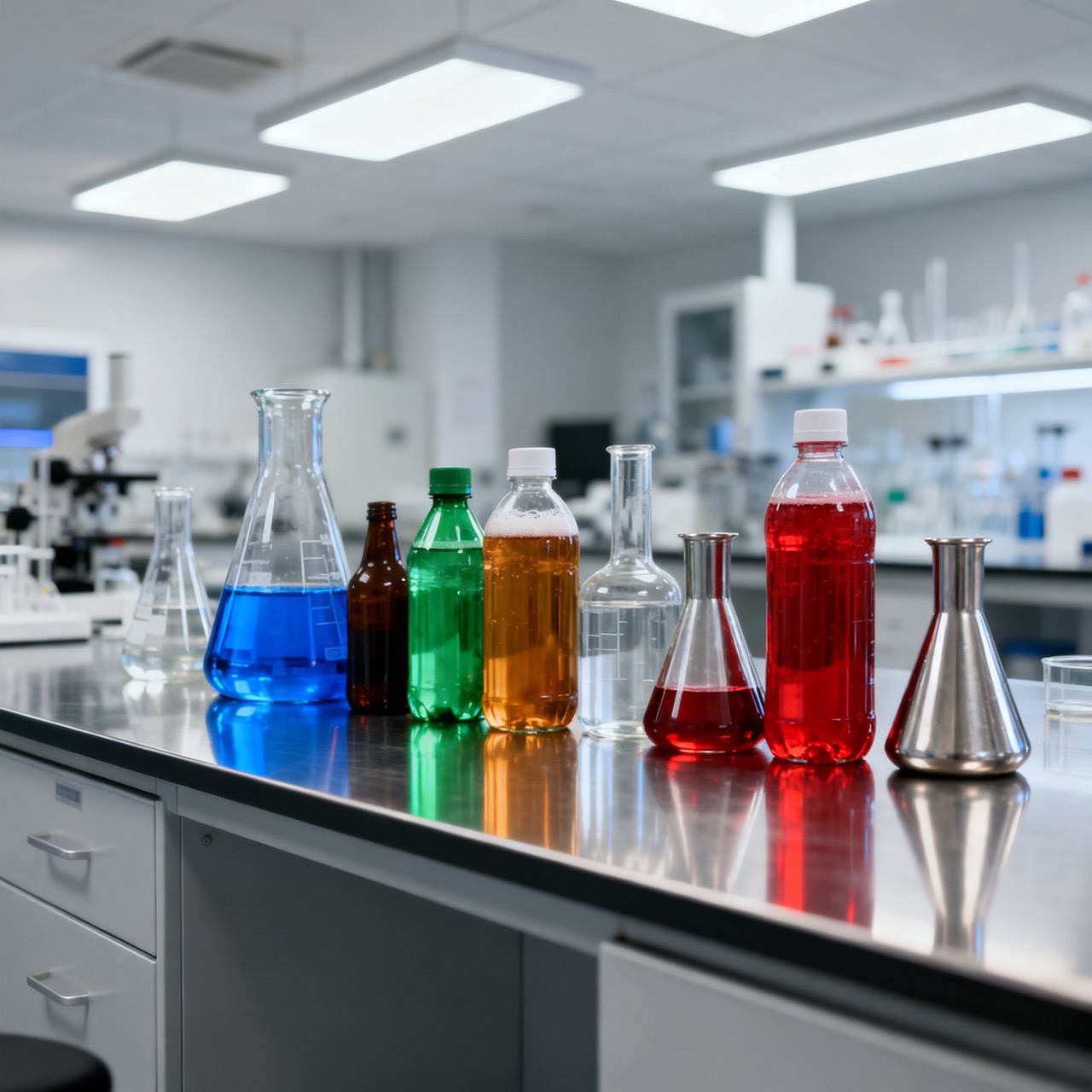
Match Color to Format
Get in touch to request samples, discuss custom formulations, or obtain volume pricing for your supply chain.
talk to a color expertWaters, juices, and clear functional drinks demand colors that stay in true solution — any haze, sediment, or ring formation is immediately visible and reads as a quality defect. Water-soluble, fully dispersed color forms are typically the starting point here.
Carbonation, along with the acidic pH common to most sodas and sparkling drinks, adds another layer of stress. Colors need to hold their hue through carbonation, bottling/canning, and often extended distribution and shelf time.
Milk, creamers, and plant-based alternatives (oat, almond, soy) introduce proteins and fats that change how a color disperses and how it's perceived against an opaque, often off-white base. Achieving a clean, consistent shade against that background is a different challenge than working in a clear matrix.
Spirits, malt beverages, and functional/energy drinks often combine multiple stress factors at once — alcohol content, added vitamins, flavor acids, and sometimes pasteurization — making them some of the more demanding beverage categories for color retention.
Most beverage applications call for water-soluble or water-dispersible colorforms. However, emulsified or oil-based systems still show up in flavored dairy or specialty drinks where fat is present. Choosing the wrong solubility profile is one of the fastest ways to introduce haze or separation.
Even a technically water-soluble color can precipitate out of solution if it's incompatible with a beverage's mineral content, pH, or other ingredients. Compatibility testing in the actual formulation — not just in water — is essential before finalizing a color choice.
Concentrates are formulated to be diluted, which means color strength has to be calculated backward from the final consumer-ready product —a common source of miscalculation if not tested at actual dilution ratios.
Powdered beverage mixes present their own considerations: color must dissolve quickly and evenly upon reconstitution, without streaking or settling before the consumer finishes the glass.
Given how differently each beverage category behaves, a technical partner who understands the specific stress factors of a client's format — carbonation, dairy fat, alcohol, fortification — can narrow a broad color palette down to a realistic shortlist before bench trials even begin.
What performs well in a small formulation trial doesn't always hold up at the production scale or during full shelf-life testing —ongoing collaboration during scale-up helps catch issues before commercial launch.

© 2026 Vivify company llc | All Rights Reserved | SITEMAP | ACCESSIBILITY statement | TERMS