Match yellow to application
Get in touch to request samples, discuss custom formulations, or obtain volume pricing for your supply chain.
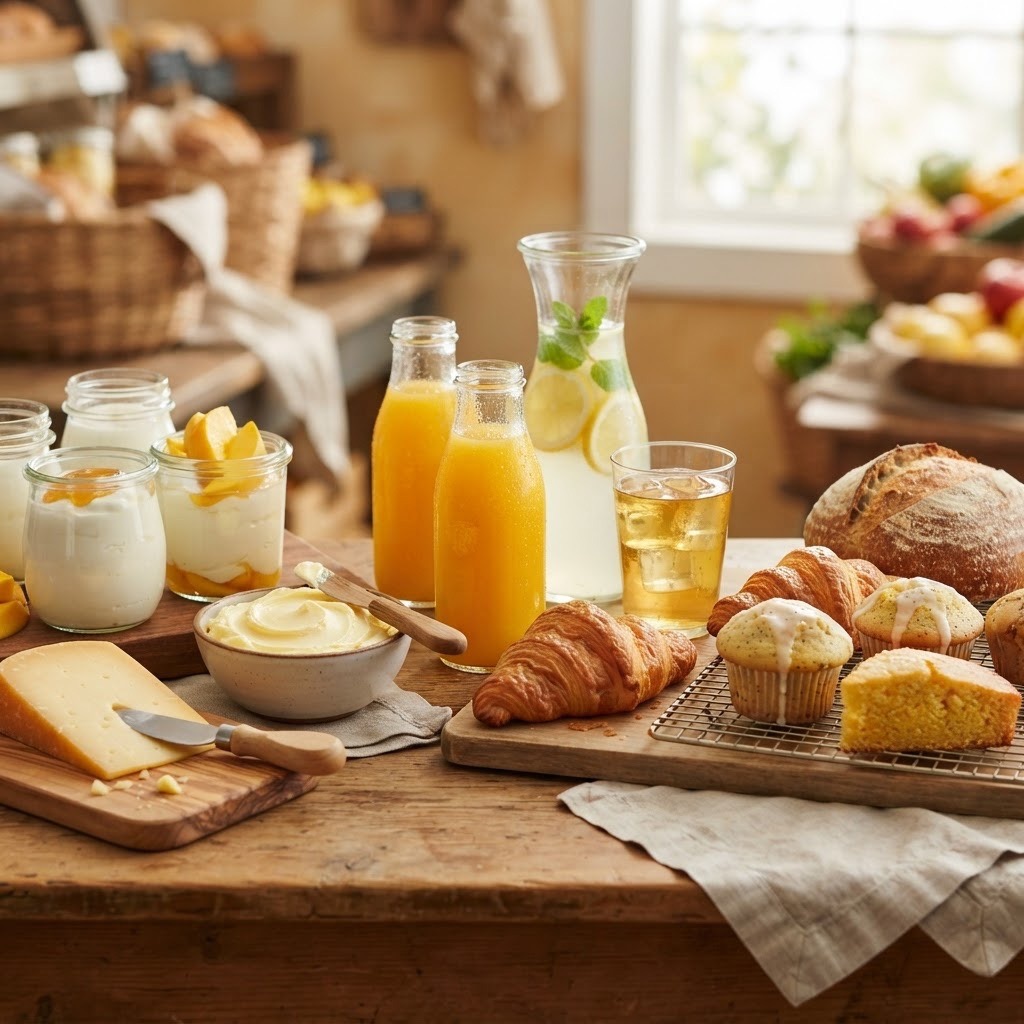
talk to a color expertDairy, beverage, and bakery products expose a yellow pigment to three genuinely different sets of conditions. Dairy blends fat and water in varying ratios depending on the product; beverages are almost entirely water-based and often acidic; and bakery products are subjected to high oven heat on top of whatever base the recipe starts with. A source that performs well in one of these three environments can perform poorly in another, which is why this post treats them as three separate decisions rather than one general yellow recommendation.
As covered in our natural yellow sources explainer, the four-core options, turmeric, riboflavin, annatto, and beta carotene, span a real range from clean lemon yellow to warm golden yellow. Because that range is wide, a mismatched source does not just look slightly off; it can appear to be the wrong color entirely, which makes getting this choice right at the application level especially important.
Butter and cheese are fat-based systems with a long formulation history built around annatto, which remains the most reliable default for a traditional golden dairy yellow. Yogurt introduces more water and typically a lower pH, which opens the door to riboflavin as an alternative, particularly where a cleaner, less golden tone is the goal. Any dairy application involving live active cultures should be tested through full shelf life, since pigment stability can behave differently in a fermenting system than in a static one.
Ice cream and other frozen desserts combine fat and water in an emulsion, making beta-carotene and turmeric both reasonable starting points, depending on the target shade. Cold storage works in the formulator's favor here, since freezer temperatures slow the oxidative and light-driven degradation that challenges these pigments at room temperature.
Clear and lightly colored beverages benefit from riboflavin's clean hue and strong heat stability, making it a dependable choice for hot-fill and pasteurized lines where other natural yellow sources might fade or shift during processing.
Juices and nutraceutical beverages, especially those with some pulp or fat content, often perform better with beta-carotene in its water-dispersible beadlet form, which disperses evenly without the clumping that a straight oil-soluble pigment can cause in a water-based product. This pairing also lets a supplement or functional beverage lean into beta-carotene's provitamin story as a secondary claim.

© 2026 Vivify company llc | All Rights Reserved | SITEMAP | ACCESSIBILITY statement | TERMS