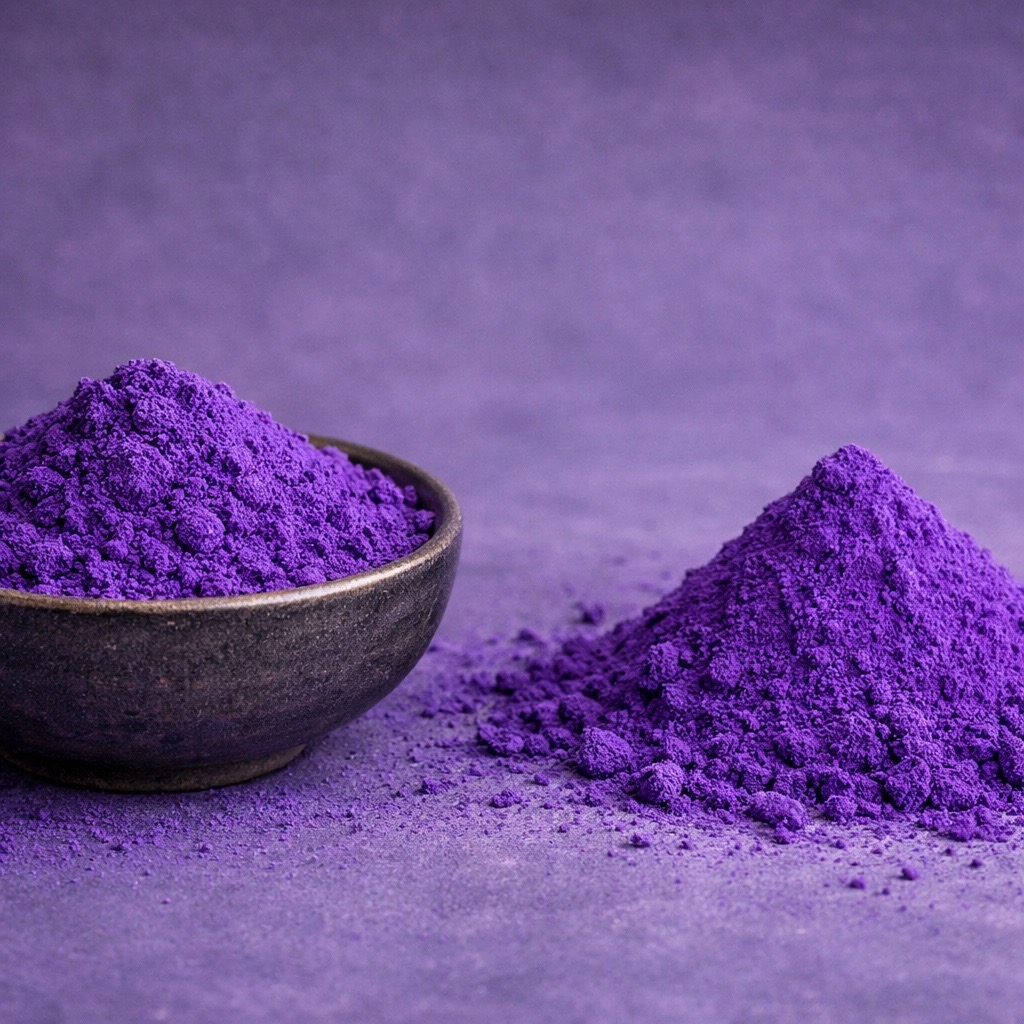
Stabilize purple with technique
Get in touch to request samples, discuss custom formulations, or obtain volume pricing for your supply chain.
talk to a color expertAnthocyanin are the same pigment family behind the reds covered in our red color series and the blue tones in butterfly pea flower extract. What determines whether a given anthocyanin appears red, purple, or blue is not a different molecule but the pH of the system it sits in, which shifts the pigment among several distinct chemical structures, each with its own color.
Anthocyanins appear red under strongly acidic conditions, shift toward purple within a narrow band around mildly acidic to near-neutral pH, and shift toward blue as conditions become more alkaline. Purple is genuinely harder to hold onto than red because it depends on landing precisely in that middle zone rather than at either end of the range, which is why a formulation targeting purple needs tighter pH control than one targeting a straightforward red.
Even a small pH change during processing or storage can nudge a carefully formulated purple toward pink or blue, often the first sign of a color stability problem, long before the pigment itself has meaningfully degraded. Ingredients added later in a formulation, packaging interactions, and even microbial activity in a product can all shift the pH enough to change the shade visibly.
Beyond pH, anthocyanins face the same heat, light, andoxidative stressors covered throughout this series, and they are among the more fragile pigment families under sustained exposure to any of the three. Left unmanaged, degradation typically appears as a fading toward brown rather than a clean loss of intensity, which can be more visually jarring than a gradual fade.
Co-pigmentation is a well-documented technique, long used in the wine industry, in which anthocyanins are paired with other polyphenols, such as tannins or flavonols, that physically stack around the pigment molecule and shield it from the water-driven degradation that causes fading. This approach can meaningfully deepen and stabilize color without changing the base pigment itself.
Because purple depends on a narrow pH band, buffering a formulation to hold steady within that range is one of the most direct and reliable ways to preserve the intended shade throughout processing and shelf life, rather than letting pH drift to wherever the rest of the recipe happens to land.
Encapsulation technologies, similar to those covered in our orange and blue color posts, can protect anthocyanins from oxygen, light, and moisture while also maintaining a stable microenvironment around the pigment that resists the broader pH of the surrounding product. This is particularly useful in complex formulations where tightly controlling the pH of the entire product is not practical.

© 2026 Vivify company llc | All Rights Reserved | SITEMAP | ACCESSIBILITY statement | TERMS